
Artists as Collateral Damage
Some thoughts on this week's environmental protest at the New York City Ballet performance

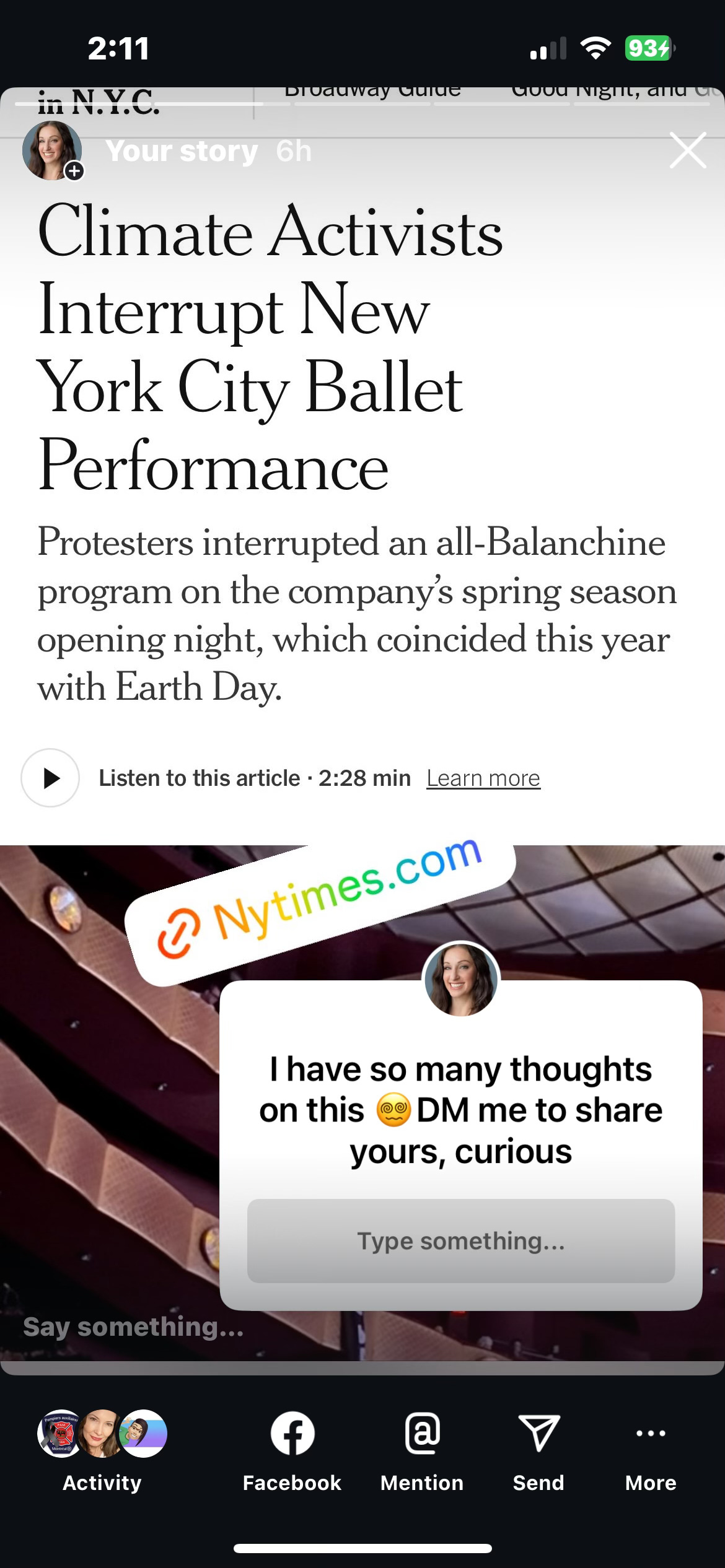
I haven’t done much on Substack because I’ve been putting all my already-limited writing time into polishing up my fourth novel, aiming to query it in the next year. I’ve reserved Ink & Pointe as a space I go when I feel something so deeply that I need to get it out somewhere (and writing is first and foremost a creative outlet in my life, just as dance is, before I treat it as a professional endeavor).
That being said, after a headline in the The New York Times yesterday upset me enough to post the above on Instagram, it was time to Substack write. I can’t even count the number of DMs, and I’m talking LONG DMs, this post led to yesterday. The Dance Lens has generated a lot of conversation on this too, and I always love Cynthia Dragoni’s deep dives, so for more on this subject when I’m done ranting I direct you there.
The headline covers it, but basically a group of protestors interrupted an opening night performance of Tiler Peck and Roman Mejia dancing Tchaikovsky Pas de Deux. They were there to protest the Koch family’s politics (this was at the David H. Koch Theater in Lincoln Center, and while the David Koch donated a boatload of money to the arts, he has also campaigned against science researching climate change). It was Earth Day, and protesters shouted “We’re in a climate emergency” and so on. The complaint being, our country is turning fascist and the wealthy and privileged are sitting here enjoying an elite art form and ignoring the world’s problems.
Boy did this stir up a lot of feelings.
On the one hand, I was raised on a small income with only one working parent, raised in a no-frills household. I was financially independent of my parents when I was eighteen when I took a full-time job as a member of one of the top 5 ballet companies—non-union—in the United States. As I recall, my starting salary was a few hundred dollars per week, and I worked six days a week and eight hours a day. When I left four years later, my pay was only negligibly higher to meet inflation. I paid rent, groceries, and car insurance, but I could never afford to eat our or buy expensive clothes or travel. I certainly couldn’t save.
One of my biggest life lessons from abandoning my ballet career earlier than most was to pivot when I was giving 110% of myself and receiving peanuts in return. It damaged me far more than I speak of in public. Situations like that are harmful and very common to artists, and I’ve run into them again and again as I’ve aged, leaving jobs and relationships when they hurt me so deeply I had nothing left to give. And it always turned out better in the end. I wish more artists knew this at a younger age and could avoid some of the heartaches I endured. It’s why I write the books I do, which are both cautionary tales and love letters to the next generation.
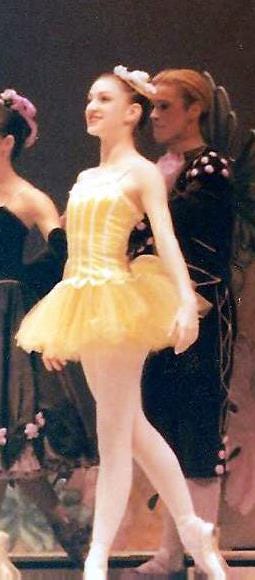
It wasn’t until my mid-thirties, when I got married, that I saved a dime, and I was still sitting on extensive unpaid college loans. And now, at 47, married with four kids, I am incredibly grateful that even with a ton of expenses, I don’t worry about money the way I used to. It might be one of the things I am MOST grateful for. But I still work in the arts (not counting the mom job, which is my hardest job) and care deeply for my colleagues, and if it weren’t for my husband I’d be earning far below the poverty line.
I am in a rare position for someone in the arts. Many at my age are still living paycheck to paycheck, and a piece of my heart will always reside with the artistic community’s needs. Covid was a nightmare for artists. Their livelihoods, and their sense of purpose and meaning in their work, were the first to go. I fear demonstrations like these will further discourage and dishearten those who put extraordinary effort with minimal payback into creating art.
When I went to college at twenty-two, I felt like an alien landing on another planet. My classmates didn’t understand what being a professional ballerina meant. Most of them had never even thought my career as I lived it existed in real life. When I think about these protesters in yesterday’s news, I can understand what they were thinking, because that ignorance of what ballet actually is, rather than what it is perceived as from a great distance, is what the majority outside the little ballet bubble believes. This is shocking to people who have spent their entire lives in a ballet studio, thinking only of ballet and meeting only ballet people. But I have seen and experienced both communities in great depth, and at different ages. I stayed away from ballet for a decade in my 20s, and now in my 40s, most of my work life is back in the ballet bubble. Now at least I have a very full life outside of it too, something I didn’t have as a professional dancer.
The protesters’ actions get at what many of us triggered by and ultimately afraid of. The real punishment went to the artists and the arts, instead of a result that made useful change. And I fear that the protestors’ reward, a big article in the New York Times, will only inspire others to repeat and escalate their actions. The incident felt like a harbinger of things to come, which is why I seem to be long-winded and unable to shut off my need to talk about this. There are so many of us whose life’s work has been supporting the arts and uplifting artists, so it feels good to be in community on this, even if it’s only a speck of the larger issues at stake.
The irony of the protestors’ misconception is similar to the Tesla protests. Most people who originally bought Teslas did not do so in support of Elon Musk. If anything it was the opposite: most originally bought electric cars, if they had the means, because they were and are lefty environmentalists. Artists and people who genuinely love and understand the arts don’t create art or cheer it on because they support wealthy elitists. And they aren’t sitting in the audience ignoring the problems of the world. If they’re at all like me, they went to a two hour ballet to escape the other 22 hours in the day they spend worrying about their loved ones, their ability to put food on the table and pay their bills, their children, where our country is going, and on and on and on.
“Over the past two decades ballet has come to resemble a dying language…Apollo and his angels are understood and appreciated by a shrinking circle of old believers in a closed corner of culture. The story—our story—may be coming to a close.
—Jennifer Homans, Apollo’s Angels, ©2010
And the dancers, musicians, lighting designers, tech crew, costume department, publicists, box office workers, admin, etc aren’t doing the work they do and shopping at high end stores. They are probably eating a slice of pizza on the street to have the cheapest dinner they can find. That’s what I did when I lived in New York and Miami on a dancer and entry-level publishing salary. Then, to add insult to injury, they are targeted because people are angry at the wealthy elite (well usually one in particular) and can’t strike back at the source of the problem.
So this brings me back to the question that I consider every time I teach a ballet class, and write book after book. (If you can’t tell, all my books, including my newest, are all about what it means to become an artist and the search for meaning in creating art). Why? Why are we doing this only to receive low pay, frequent lack of respect in the workplace and in society, and now, a government and protestors both using artists and their work as collateral damage for their agendas based on anger, politics, and generally everything BUT our purpose in making art, which is to make people’s lives a bit more joyous, a bit more thoughtful, and bit more communal? To give from our heart, to love others as we should love ourselves?
I don’t have the answers but I have been searching for them since I was a child and continue asking these questions today. And one of my biggest questions, is what can we actually DO (because I’m Jewish, and Jews are frequents scapegoats too, and we believe doing is the most important mitzvah of all). What can we actually do, as individuals, that will make the world better and bring the change we want to see in the world? It’s not ruining a ballet performance.
For now, since I can’t think of anything that I have in me that’s better, I’m making more art, and using my voice.
If you have more ideas, please put them in the comments, and if you’re willing to share this Substack and recommend my books, I’d be grateful.
“If we are lucky, I am wrong and classical ballet is not dying but falling instead into a deep sleep…if artists do find a way to reawaken this sleeping art, history suggests that the kiss may not come from one of ballet’s own princes but from an unexpected guest from the outside…from artists or places foreign to the tradition who find new reasons to believe in ballet.
—Jennifer Homans, Apollo’s Angels, ©2010
Love this article
Thanks so much for contributing to this important conversation, Miriam. We all have our voices, and I'd also love to hear more from the young NYC company members (who probably aren't allowed to say much, unfortunately). I think you're probably right that for activists shock value is all--and important to their cause. Like you said, they got big press, and that is really valuable for their mission. I thought Cynthia Dragoni's point about the elitist nature of the ballet at present (despite companies' lip service that they want to re-make the whole ballet experience for a new audience)--no "cheap" seats released until all the $125 seats are filled--is an important one. The last ballet performance I saw was the Paris Opera's performance of Swan Lake--on IMAX, because it was only $25. The last live performance was of our (pretty terrible, honestly) regional company. The $65 tickets--one for me and one for my husband--were Christmas gifts from my sister-in-law. That's pricey for our budget. $125-tickets feels like an insult, especially when companies talk about wanting to change. Maybe activists will make them change. I don't like art to be ruined--whether by someone throwing paint on a Monet or by interrupting a night at the ballet. But I can understand why they resort to these actions.